
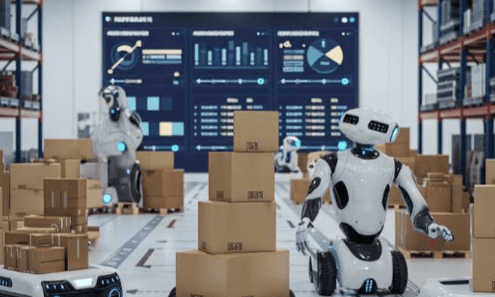
Artificial Intelligence in warehouse robotics integrates perception, planning, and action into a data-driven stack that translates sensory input into executable tasks. The focus is on low latency, ensemble reasoning, and calibrated sensing to improve accuracy and fault tolerance. Data-centric optimization accelerates perception, planning, and execution, while edge computing and closed-loop adjustments enable real-time governance. The result is higher picking precision and faster cycle times, but practical deployment raises questions about cost, adaptability, and transparency that merit careful scrutiny.
What AI Brings to Warehouse Robotics
AI enhances warehouse robotics by enabling perception, decision-making, and autonomous action that collectively optimize throughput and accuracy.
In practice, AI-driven systems leverage data labeling to train robust models, while awareness of selection bias preserves generalization across diverse environments.
This enables scalable calibration, real-time adaptation, and fault tolerance, delivering measurable improvements in picking precision, cycle times, and operational reliability across heterogeneous warehouse networks.
Perception, Planning, and Action: The AI Stack in the Warehouse
Perception, planning, and action form a tightly coupled stack that translates sensor data into executed tasks with minimal latency.
In warehouse contexts, perception biases are mitigated through calibrated sensing and ensemble reasoning, while planning ethics govern task prioritization under constraints.
The architecture emphasizes data-centric optimization: faster perception, robust planning, and reliable execution, enabling adaptable, freedom-friendly autonomous workflows with measurable performance gains.
Real-World Use Cases: AI-Driven Inventory, Picking, and Navigation
How do AI-driven systems transform inventory accuracy, picking speed, and navigational reliability in real-world warehouses? Real-world deployments show measurable gains from AI driven calibration and edge deployment, enabling closed-loop adjustments, faster SKU recognition, and obstacle-averse routing.
Data-centric analytics optimize rack placement and workflow, reducing travel time, boosting pick rates, and enhancing validation workflows without centralized delays.
How to Evaluate AI-Enhanced Robotics Solutions
Evaluating AI-enhanced robotics solutions requires a data-driven, metrics-first approach that prioritizes operational impact over novelty. In practice, objective benchmarks, pilot results, and robust monitoring drive selection. Emphasize data governance to ensure quality, lineage, and security, and address ethical deployment to prevent bias and unintended consequences. Frame decisions around throughput, reliability, and total cost of ownership, promoting transparent, freedom-minded optimization.
Frequently Asked Questions
How Is Data Privacy Managed in Warehouse AI Systems?
Data privacy in warehouse AI systems is managed via robust data governance frameworks and continuous privacy audits, ensuring compliant data handling, access controls, and traceability while prioritizing secure, optimized operations for stakeholders seeking freedom and efficiency.
What Are the Long-Term Maintenance Costs for AI Robots?
A 40% reduction in downtime signals long-term maintenance costs are manageable. The analysis shows maintenance budgeting and lifecycle depreciation dominate over initial purchase, with predictive servicing extending asset life and enabling optimization of warehouse AI deployment.
See also: How Artificial Intelligence Makes Devices Smarter
Can AI Adapt to Sudden Layout Changes in Warehouses?
The system can adapt to sudden layout changes through adaptive routing, leveraging real time anomaly detection to reconfigure paths, optimize throughput, and maintain reliability, delivering data-driven insights for autonomous adjustment while preserving operational freedom and efficiency.
How Does AI Handle Safety-Critical Decision Failures?
Safety critical decisions are managed via redundant validation, failover protocols, and human-in-the-loop review. Failure handling relies on traceable data integrity, rollback mechanisms, and robust monitoring, prioritizing operational continuity while preserving freedom to adapt workflows and optimization objectives.
What Skills Are Needed to Manage Ai-Powered Warehouses?
Tech leadership requires adaptability and talent acquisition, focusing on data privacy and maintenance costs. The role emphasizes safety failures prevention, data-driven optimization, and risk-aware decision making, preparing managers to steer AI-powered warehouses with freedom and responsibility.
Conclusion
In the warehouse of the future, AI is the impartial foreman: data-driven, relentlessly optimizing routes, times, and labels. Perception flags misplacements; planning retools the schedule; action follows with minimal lag. Sensors gossip with edge compute, while governance audits every tidy bin and KPI. Satire aside, the takeaway is practical: rigorous metrics, closed-loop feedback, and scalable AI-augmented workflows yield higher pick accuracy, shorter cycle times, and lower total cost of ownership—delivering productivity with a smile and a ledger.
